 Hajun Jung
In November, Tokyo and Osaka call for late-autumn outerwear. Tokyo's normal November high is about 16.7℃, but the normal low is about 8.8℃. If you pack light based only on daytime temperatures, nights can catch you out [1][1]. Osaka is similar, with a normal high of about 17.8℃ and a low of about 10.2℃ [1]. Sapporo's normal November low is 1.6℃, so it needs completely different preparation from Tokyo [1]. Naha in Okinawa is at the other end, with a normal November low of 20.4℃ [1]. The temperatures in this article are Japan Meteorological Agency (일본기상청) 1991~2020 climate normals. They are not a weather forecast for a specific travel day in 2026 [1].
November Normal Temperatures by Japanese City at a Glance
These are the November normal highs and lows for Sapporo, Tokyo, Osaka, Fukuoka and Naha, with a sense of what to wear. They are based on Japan Meteorological Agency 1991~2020 normals [1].
| City | November normal high | November normal low | What to wear |
|---|---|---|---|
| Sapporo | About 8.7℃ | About 1.6℃ | Prepare almost as for winter [1] |
| Tokyo | About 16.7℃ | About 8.8℃ | Late-autumn outerwear needed [1] |
| Osaka | About 17.8℃ | About 10.2℃ | Cool by day, chilly at night [1] |
| Fukuoka | About 18.2℃ | About 10.6℃ | Mainly autumn jackets [1] |
| Naha | About 25.0℃ | About 20.4℃ | Much lighter clothing than the mainland [1] |
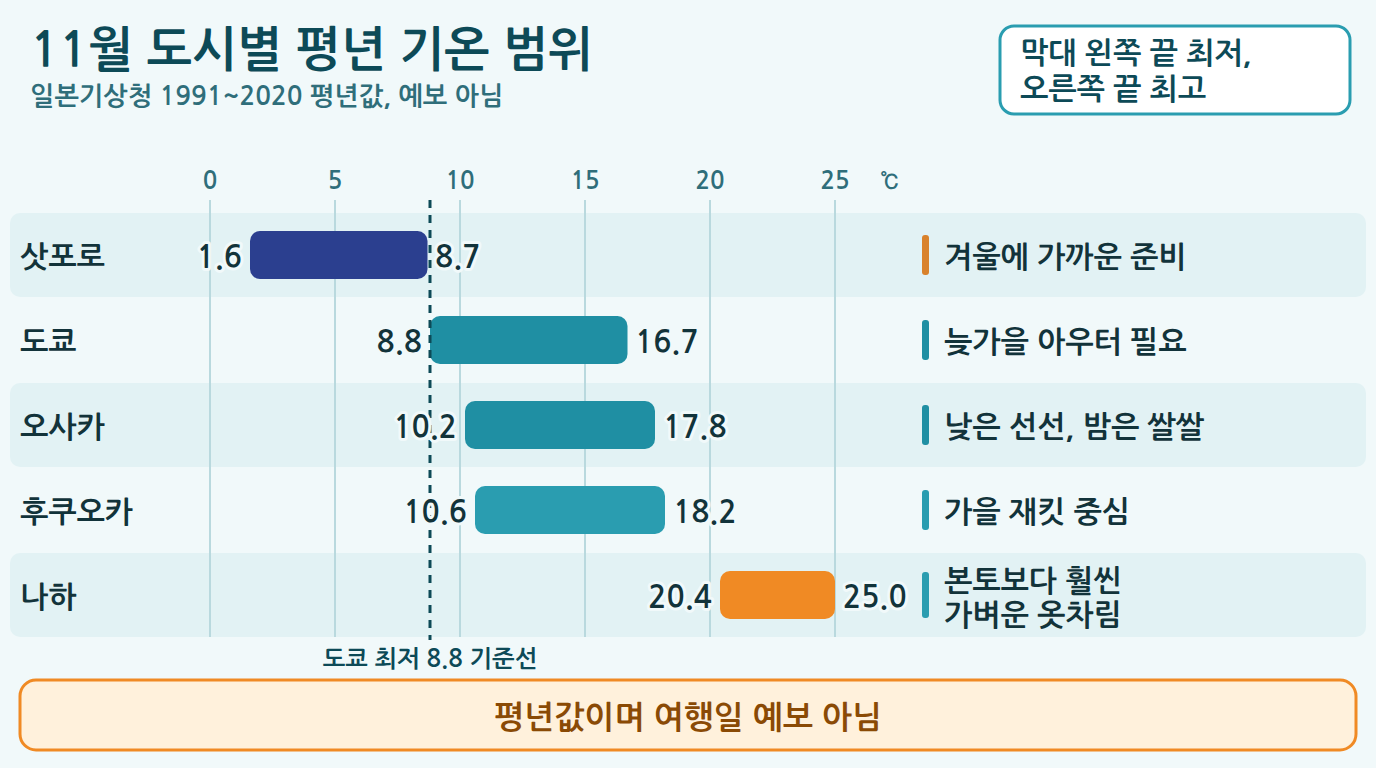
Sapporo and Naha differ so much that they hardly seem to be in the same month [1]. If you make one standard for all of Japan, it will be wrong everywhere. Normals are averages over several decades. They do not tell you about warm or cold days that may fall in your travel week. A safe approach is to set the main outline of your packing from the normals, then add or remove one layer of outerwear based on the forecast just before departure.
Why Daytime Temperatures Alone Fail: Morning, Evening and Night Plans
In November, if you prepare clothes based only on daytime temperatures, it is easy to get it wrong [1]. The gap between day and night can be large, and autumn leaf illuminations are held at night [1]. Following a day's route shows why.
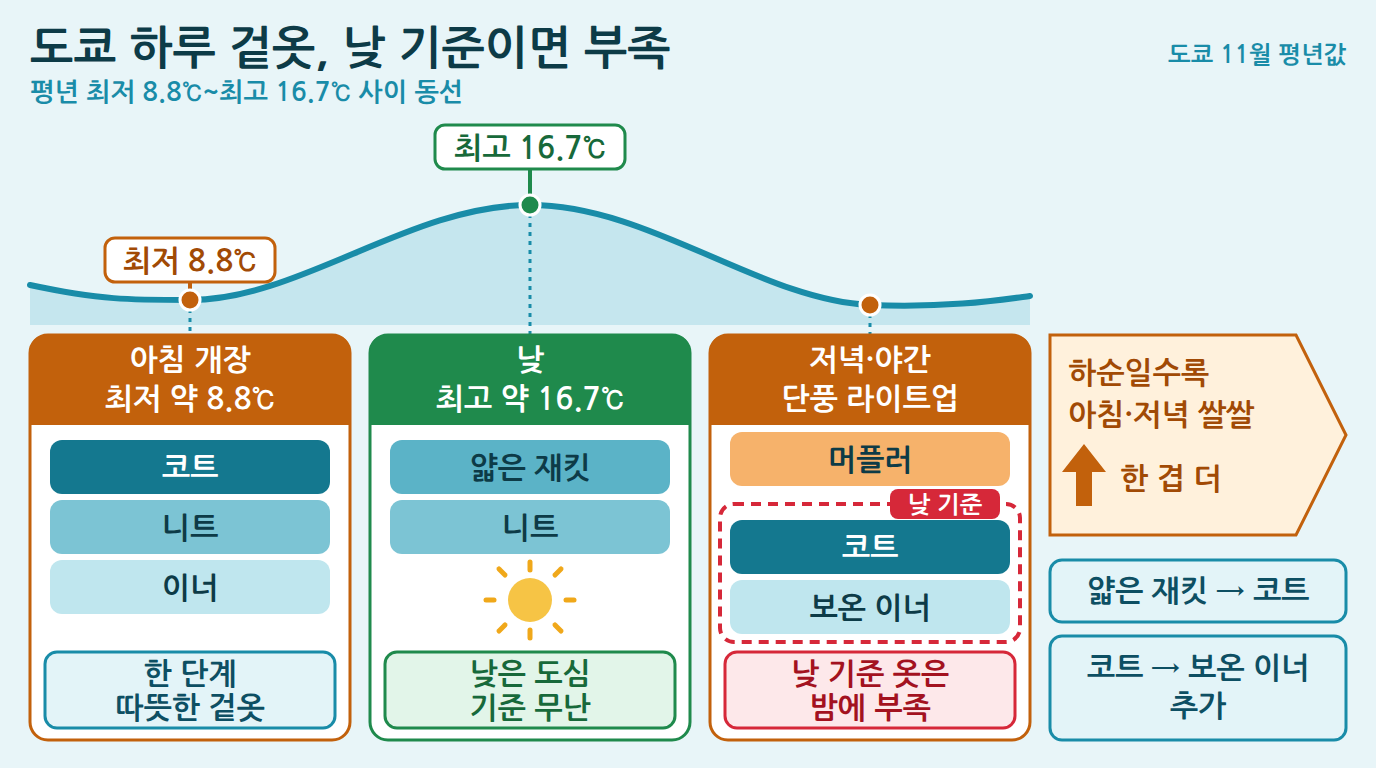
- Morning opening hours: If your plans follow morning opening times, you need to consider the felt temperature [1]. Tokyo's normal November low is about 8.8℃ [1].
- Daytime: Tokyo's normal November high is 16.7℃ and Osaka's is 17.8℃ [1]. In city centers, daytime is a relatively easy range [1].
- Evening and night: Autumn leaf illuminations are held at night, so dressing for daytime temperatures may not be enough [1]. Osaka's normal November low of 10.2℃ also feels chilly on night outings [1].
The rule is simple. If you move around at morning opening times or add a special night viewing, it is better to bring outerwear one step warmer than for city sightseeing in Tokyo or Osaka [1]. If you planned a thin jacket for daytime, take a coat. If you planned a coat, add one more warm inner layer. Also, mornings and evenings clearly get chillier toward the end of the month. Even within November, it is better to choose warmer outerwear for a late-month trip than for early November [1].
November Clothing for Tokyo, Osaka and Fukuoka: Early vs. Late Month
In these three cities, the normal November highs are 16.7℃ in Tokyo, 17.8℃ in Osaka and 18.2℃ in Fukuoka. The lows are 8.8℃, 10.2℃ and 10.6℃ respectively [1]. You can pack the same set of clothes for all three cities [1].
- Long-sleeved tops
- A knit or sweatshirt
- A light jacket or coat
- Long pants
- Sneakers that are comfortable for long walks
- A thin scarf or warm outerwear if you have many night plans
Early in November, daytime can feel fairly mild, but mornings and evenings clearly get chillier toward the end of the month [1]. In early November, plan around a light jacket. In late November, make a coat your base and adjust by removing or adding the layers underneath [1]. In Tokyo and Osaka city centers, a late-autumn coat or jacket with layering is generally easier to use. However, if you feel the cold easily or have long night plans, it is right to increase warmth [1].
If autumn leaves are your goal, also look at timing. In big cities such as Tokyo, Kyoto and Osaka, the autumn leaves get properly good from late November, and in some areas they continue into December [1]. So for big cities, after late November is often better [1]. If you time your trip to the autumn leaves, your clothing also moves to the late-month standard, that is, toward a coat.
November Clothing for Sapporo, the North and Highlands: When You Need Winter Preparation
In November, Hokkaido and highland areas are too cold to prepare only a thin jacket just because the trip is called an "autumn trip" [1]. Sapporo's normal November high is only about 8.7℃, and its normal low is about 1.6℃ [1]. At this level, the following set is realistic [1].
- A warm coat or padded outerwear
- Warm inner layers
- Gloves and a scarf if you feel the cold easily
Snow depends on the region. In Hokkaido and in the north and highlands, you should consider the chance of snow or near-winter weather in November [1]. However, it is not appropriate to plan a Tokyo or Osaka city trip on the assumption of November snow [1]. Shoes also differ. In Tokyo and Osaka city centers, the standard is sneakers that are comfortable for long walks [1]. In the north and highlands, where you should consider the chance of snow, it is hard to use the same standard as is [1].
You can also reduce the burden through your choice of schedule. For Hokkaido and the north and highlands, early to mid-November may be more suitable [1]. In early November, the north and mountain areas have already entered late autumn or early winter [1]. If you include Hokkaido in late November, start packing on a winter basis, not an autumn one.
Okinawa's Naha Is the Opposite: When Light Clothing Is Enough
In Naha, the normal high is about 25℃ even in November [1]. The normal low is also about 20.4℃ [1], so much lighter clothing than on the mainland is possible [1]. Compared with Tokyo's normal November low of 8.8℃, night temperatures are in a completely different range [1].
Here is how to cut down your luggage. Leave out coats and thick knits, and keep just one thin layer of outerwear for the cabin or for travel [1]. If you visit only Naha, you do not need to carry luggage packed for the mainland. If you combine the mainland and Naha in one trip, you can split it up: wear thick outerwear only on the mainland leg and dress lightly in Naha [1].
Rain and Autumn Leaf Crowds: What to Check Before Planning November
Major Pacific-side cities such as Tokyo and Osaka are relatively comfortable to travel in compared with midsummer or early autumn [1]. You should also look at rainfall. In the Japan Meteorological Agency 1991~2020 normals, November rainfall is about 96.3mm in Tokyo and about 72.5mm in Osaka [1].
| City | November normal rainfall | Planning |
|---|---|---|
| Tokyo | About 96.3mm [1] | For city sightseeing, prepare indoor options as well |
| Osaka | About 72.5mm [1] | Easy to switch to indoor plans such as food and shopping [1] |
Regions on the Sea of Japan side have different weather characteristics even in the same month, so you should not conclude that "November is dry" nationwide [1]. Do not apply the Tokyo and Osaka figures to all of Japan.
It is risky to treat a single day as the right answer for autumn leaf plans. Autumn leaves vary with altitude, terrain such as north-facing or south-facing slopes, tree species, the temperatures of that year's September to November, the urban heat island effect, and the microclimate around valleys and lakes. So rather than fixing on one day as the absolute answer, as in "Tokyo's autumn leaves are on November 29", it is safer to prepare 2~3 candidates in the city and suburbs and check the actual color change just before your trip [1].
Crowds are also a variable. Not all of November is a major holiday season in Japan, but in areas nearing peak autumn color, tourists can concentrate around weekends [1]. In Tokyo, famous autumn leaf spots are crowded. Kyoto has a strong combination of temples, gardens and autumn leaves, but is very crowded in the autumn leaf season [1]. Looking at the city itself, Osaka has a weaker traditional autumn leaf image than Kyoto, but indoor options and easy travel around Kansai help reduce the risk of missing the autumn leaves [1]. For a first trip, Tokyo is easier to plan. If you want varied backup plans and day trips around Kansai, Osaka is easier to plan [1].
Packing Order Before You Leave: Final Check by Destination and Time of Day
- Choose your destination. It splits into winter preparation for Sapporo, the north and highlands, late-autumn layering for Tokyo, Osaka and Fukuoka, and light clothing for Naha [1][1].
- Check your earliest and latest plans. If you have a morning opening or a special night viewing, move up to outerwear one step warmer than for city sightseeing in Tokyo or Osaka [1].
- Confirm your outerwear. For Tokyo, Osaka and Fukuoka, it is a light jacket or coat. For Sapporo, it is a warm coat or padded type [1][1].
- Choose your inner layers. Make long-sleeved tops with a knit or sweatshirt the base, and add warm inner layers for Sapporo [1][1].
- Decide shoes and bottoms. Long pants and sneakers that are comfortable for long walks are the standard for big cities [1].
- Add accessories. If you have many night plans, pack a thin scarf or warm outerwear. If you feel the cold easily in Sapporo, pack gloves and a scarf [1][1].
- Check if you feel the cold easily. Even in Tokyo and Osaka city centers, if you feel the cold easily or have long night plans, raise the warmth by one step [1].
- Check just before departure. Normals are not a forecast, so adjust your outerwear after looking at the forecast for your travel week and the autumn leaf color status [1][1].
Frequently Asked Questions
Q1. Can I assume November is dry everywhere in Japan?
No, you should not assume that. Major Pacific-side cities such as Tokyo and Osaka tend to be easier to travel in than in midsummer or early autumn [1]. However, regions on the Sea of Japan side have different weather characteristics even in the same month, so you should avoid a nationwide conclusion [1]. Even Tokyo's normal November rainfall is about 96.3mm, so it is safer to prepare a rain jacket or indoor options [1].
Q2. Should I prepare for snow in Tokyo and Osaka in November?
For city trips, late-autumn layering comes before snow preparation [1]. The places that need to consider snow or near-winter weather are Hokkaido and the north and highlands [1].
Q3. Can I fix an autumn leaf date and book?
There are too many variables to treat a single day as the right answer. Altitude, terrain, tree species, the temperatures of that year's September to November and the urban heat island effect all have an influence. So it is safer to keep 2~3 candidates in the city and suburbs and check the color change just before your trip [1].