 Chaewon Kang
Infant and child health checkups total 12 visits: 8 general checkups and 4 dental checkups [1]. General checkups are given at 14 to 35 days after birth [1], 4 to 6 months [1], 9 to 12 months [1], 18 to 24 months [1], 30 to 36 months [1], 42 to 48 months [1], 54 to 60 months [1], and 66 to 71 months [1]. The 4 dental checkups must be done separately at a dental clinic, not at a pediatric clinic [1]. All infants and children living in Korea are eligible, from 14 days after birth until under 6 years of age (71 months) [1]. Unlike adult national health screenings, infant and child checkups in principle have no deferral application or extension for missed checkups from a previous year [1]. You need to prepare the questionnaire for that round and a consultation memo noting your child's feeding, sleep and so on [1][1].
Infant and Child Checkup Schedule by Age: 8 General and 4 Dental Checkups
The infant and child health checkup program assesses growth and possible developmental delay from 14 days to 71 months of age [1]. It is also a state-supported welfare program in which the National Health Insurance Service (국민건강보험공단) covers the full cost of the checkups [1]. The general and dental checkup periods overlap, so it is less confusing to see them in age order on one page.
| Type | Period | Main content |
|---|---|---|
| General checkup 1 | 14 to 35 days after birth | A checkup of early newborn health [1] |
| General checkup 2 | 4 to 6 months after birth | Assesses early gross motor skills such as holding up the head and rolling over [1] |
| General checkup 3 | 9 to 12 months after birth | Observes mobility skills such as sitting alone, crawling and standing while holding on [1] |
| General checkup 4 | 18 to 24 months after birth | The Korean Developmental Screening Test for Infants and Children (K-DST) is fully carried out from this period [1] |
| Dental checkup 1 | 18 to 29 months after birth | The period when baby teeth come in; checks tooth alignment and congenital missing teeth [1] |
| General checkup 5 | 30 to 36 months after birth | Closely assesses language development such as combining words and speaking in sentences [1] |
| Dental checkup 2 | 30 to 41 months after birth | The stage when all 20 baby teeth have come in [1] |
| General checkup 6 | 42 to 48 months after birth | Detailed refraction testing and vision measurement with a picture eye chart begin [1] |
| Dental checkup 3 | 42 to 53 months after birth | Assesses the risk of dental caries (cavities) and observes gum health [1] |
| General checkup 7 | 54 to 60 months after birth | Focuses on interaction with peers and emotional and social development [1] |
| Dental checkup 4 | 54 to 65 months after birth | Checks readiness for baby teeth falling out and permanent teeth coming in [1] |
| General checkup 8 | 66 to 71 months after birth | The last comprehensive checkup before elementary school [1] |
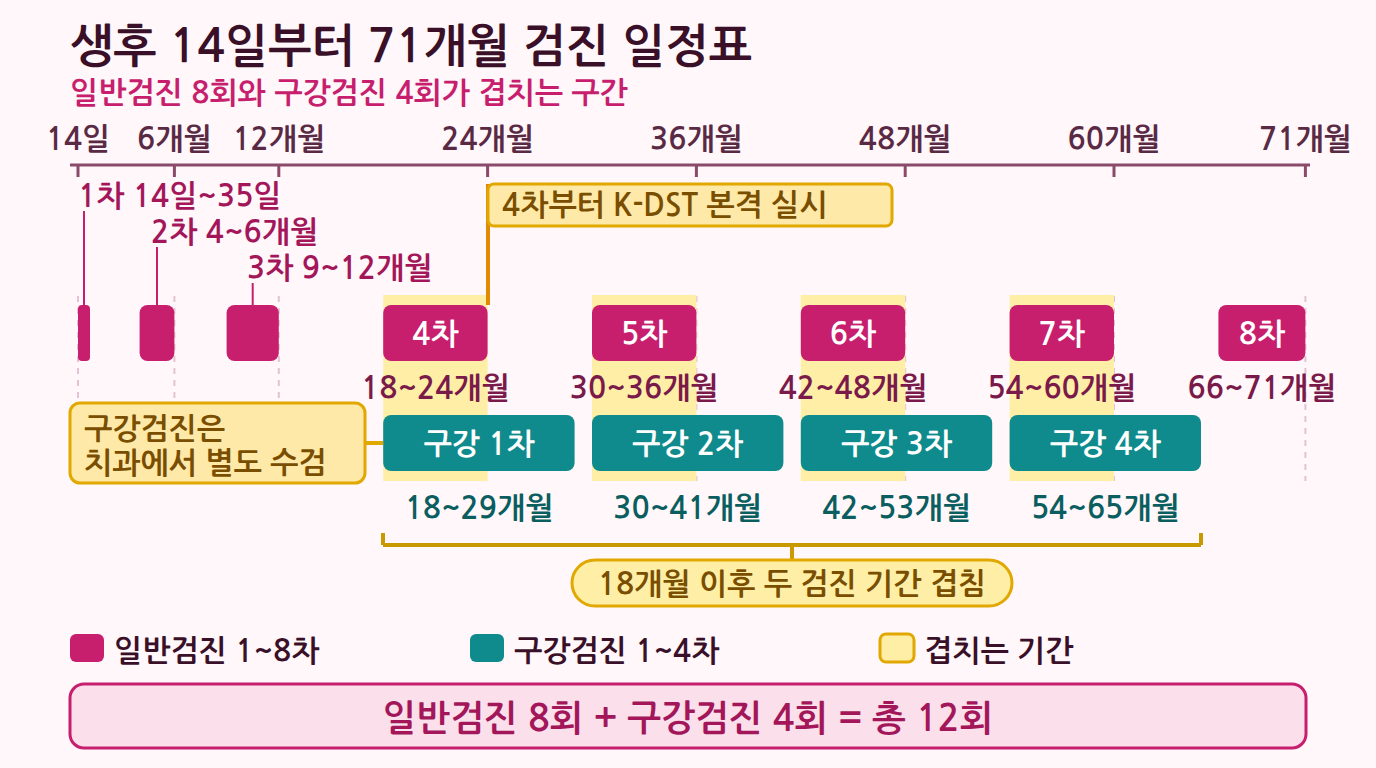
As the table shows, the general and dental checkup periods overlap after 18 months of age. In some periods you can get both checkups in the same month, so pick days when your child is well and book each facility separately.
What Each Round Checks: How Rounds 1 to 8 Differ
The checkups do not repeat the same tests. The areas they emphasize change with age. The focus starts with body movement and widens to language, vision and social skills.
- Rounds 1 and 2 (start of motor development): Rounds 1 and 2 rely mainly on the questionnaire [2]. Round 1 checks early newborn health between 14 and 35 days after birth [1], and round 2 assesses holding up the head and rolling over between 4 and 6 months [1].
- Round 3 (mobility): Between 9 and 12 months, sitting alone, crawling and standing while holding on are observed [1].
- Round 4 (K-DST in full): Between 18 and 24 months, the Korean Developmental Screening Test for Infants and Children (K-DST) is fully carried out [1].
- Round 5 (language): Between 30 and 36 months, language development such as combining words and speaking in sentences is closely assessed [1].
- Round 6 (vision): Between 42 and 48 months, detailed refraction testing and vision measurement with a picture eye chart begin [1].
- Round 7 (social skills): Between 54 and 60 months, the focus is on interaction with peers and emotional and social development [1].
- Round 8 (overall check before school): Between 66 and 71 months, the last comprehensive checkup before elementary school is given [1].
Sources differ slightly on when K-DST starts. Some sources explain that age-appropriate K-DST questions are activated from the round 3 checkup [2], and others explain that it is required from round 4 [1]. Either way, if your child's round 3 checkup is coming up, check yourself whether the questionnaire you choose includes K-DST questions [1]. If it does, it is better to fill it in before the visit.
Dental Checkups Are Done Separately at a Dental Clinic
If you assume you will get it at the same clinic as the general checkup, it is easy to miss, so arrange it separately. Here is what the dentist checks in each round.
- Round 1 (18 to 29 months after birth): The period when baby teeth come in. The dentist checks the alignment of the baby teeth and congenital missing teeth [1].
- Round 2 (30 to 41 months after birth): The stage when all 20 baby teeth have come in [1].
- Round 3 (42 to 53 months after birth): Assesses the risk of dental caries (cavities) and observes gum health [1].
- Round 4 (54 to 65 months after birth): Checks readiness for baby teeth falling out and permanent teeth coming in [1].
To choose a dental clinic, use the 'Find a Screening Facility' menu on the Service's website, apply the 'Infant and Child Checkup' filter, and search for clinics near your home [1]. Both pediatric clinics and dental clinics appear in the search, so you need to look for each one separately.
What to Prepare Before the Checkup and the Order for Filling In the Questionnaire and K-DST
To avoid rushing at the clinic on the day, there are things to do before you visit. The order is as follows.
- Find facilities: Use the method described above to find and book a pediatric clinic and a dental clinic separately [1].
- Fill in the questionnaire and K-DST: Choose the questionnaire for your child's round, select the K-DST (Korean Developmental Screening Test for Infants and Children), which is required from the round 4 checkup, and complete the survey [1].
- Set a password: After finishing, you must set a 4-digit password (registration number) [1].
- Prepare a consultation memo: Write in your smartphone's notepad your child's daily amount of milk and meals, sleep pattern, media exposure time, and any behavior that particularly worries you [1].
- Visit the facility: Visit the facility with the 4-digit password you set and your memo [1][1].
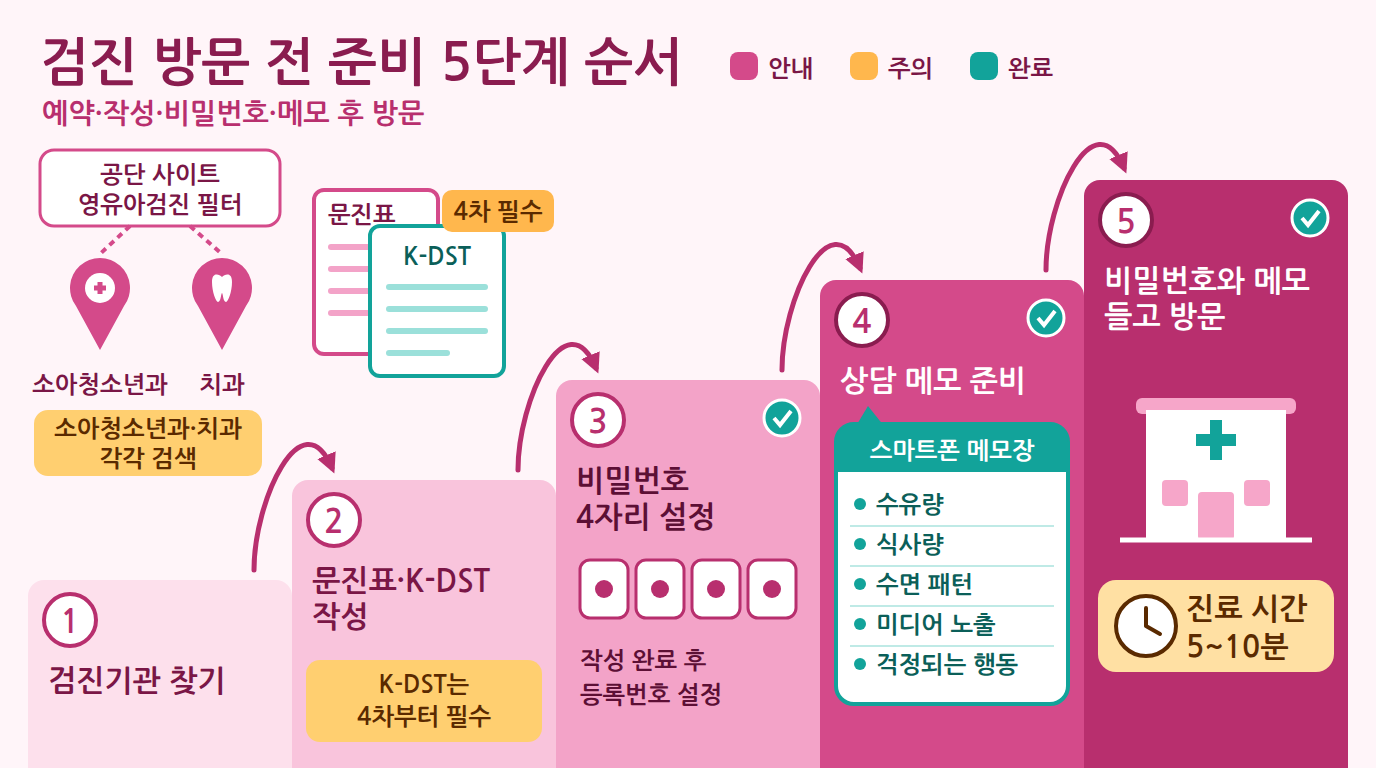
The memo helps you make good use of the short consultation time. Because the consultation lasts only 5 to 10 minutes, writing things down in advance lets you have a more focused talk [1]. Check the items below before you leave.
- Did you fill in the questionnaire for that round?
- If that round has K-DST questions (required from round 4), did you also finish the survey? [1]
- After filling it in, did you set the 4-digit password (registration number)? [1]
- Did you prepare the consultation memo? [1]
- Did you choose separate facilities for the general checkup and the dental checkup? [1]
If You Missed the Checkup Period: Extension, Deferral and Cost
So the surest preparation is to manage the schedule in advance, starting from the beginning of each round. Rather than counting on a relief system, plan to book before the period for each round ends.
As a rule, the National Health Insurance Service covers the full cost [1]. However, when you do have to pay, it is about KRW 10,000 to KRW 30,000 for a general checkup, and it may differ by clinic [3]. If you ask the facility before booking whether any cost applies, you are less likely to be caught off guard on the day.
- Check your child's next round on the schedule and add it to your calendar alerts.
- Set two alerts, one when the period starts and one before it ends, so you can book with time to spare.
- Register the general checkup and the dental checkup separately so the dental checkup is not missed [1].
- Before booking, ask the facility whether there is a cost [3].
Frequently Asked Questions
Q1. Can I get the general checkup and the dental checkup at the same clinic in one visit?
The dental checkup must be done separately at a dental clinic or hospital, not at a pediatric clinic [1]. Book the general checkup at a pediatric clinic and the dental checkup at a dental clinic, each separately. You can find both on the Service's 'Find a Screening Facility' page with the 'Infant and Child Checkup' filter [1].
Q2. When do I have to pay for a checkup?
The infant and child checkup is a program in which the National Health Insurance Service covers the full cost [1]. The amount may differ by clinic [3], so please ask the facility directly when you book.
Q3. What happens if I miss the checkup period by a day or two?
What has been confirmed is that, in principle, there is no deferral or extension system for checkups missed in a previous year [1]. If you are a few days late, ask the facility directly how it is handled, and in the future set a calendar alert for the start of each round.
Q4. What should I bring for my child on the day of the checkup?
Before the visit, fill in the questionnaire for that round, and also finish the K-DST survey, which is required from the round 4 checkup [1]. Remember the 4-digit password (registration number) you set after filling it in [1]. Do not forget to bring your consultation memo [1].