 Seoa Yoon
Beef and radish soup for 4 servings uses 200 g of beef (brisket), 1/4 radish, and 6 cups of kelp and anchovy broth. Soak the beef in cold water to draw out the blood, then season it. Stir-fry the beef first, add the radish, and simmer in the broth. These amounts are for 4 servings. [1] Soak the beef in cold water for 10 minutes. [1] Let the seasoned beef rest for 10 minutes as well. [1] Cut the radish into 3 cm squares (nabak-sseol, a square, flat cut). [1] After covering the pot, keep simmering for at least 20 minutes without stopping. [2] The reference date is November 2026.
Ingredients and Measurements for 4 Servings at a Glance
Before shopping, check the ratio of beef to radish. A ratio of about 1:2 is suitable. [3] Think of it as preparing more radish than beef. Check that the beef is bright red. Choose a radish that is firm, not soft, and fresh. [3]
| Category | Ingredient and amount | Use |
|---|---|---|
| Main ingredient | Beef (brisket), 200 g for 4 servings [1] | Cut into soup-sized pieces and remove the blood |
| Main ingredient | 1/4 radish, cut into 3 cm squares [1][1] | Stir-fry with the beef, then simmer |
| Secondary ingredient | 1/2 stalk of green onion, halved and cut into 4 cm lengths [1][1] | Added at the finishing stage |
| Broth | 6 cups of kelp and anchovy broth [1] | Simmering liquid |
| Beef seasoning | 1/2 tablespoon soup soy sauce (guk-ganjang), 1 teaspoon minced garlic, 1 teaspoon sesame oil, a little salt and pepper [1] | Mix into the beef after removing the blood |
| Broth seasoning | 1 tablespoon soup soy sauce, 1/2 tablespoon minced garlic, 1/2 teaspoon salt, a little pepper [1] | Adjust the seasoning while simmering |
How to Remove Blood from Beef and Season It (10 Minutes)
The broth is cleaner if you remove the blood before simmering. Soak the beef in cold water first, and prepare the other ingredients in the meantime. The steps are as follows.
- Soak the beef in cold water for about 10 minutes to draw out the blood. [1] If the water turns red, change it once.
- Drain it and cut it into bite-sized pieces. [1] If the pieces are an even size, they cook at the same speed.
- Press the surface dry with a paper towel. If water remains, the seasoning becomes thin, and later the beef will be boiled instead of stir-fried.
- Mix the beef with the seasoning ingredients (1/2 tablespoon soup soy sauce, 1 teaspoon minced garlic, 1 teaspoon sesame oil, a little salt and pepper) and let it rest for about 10 minutes. [1][1]
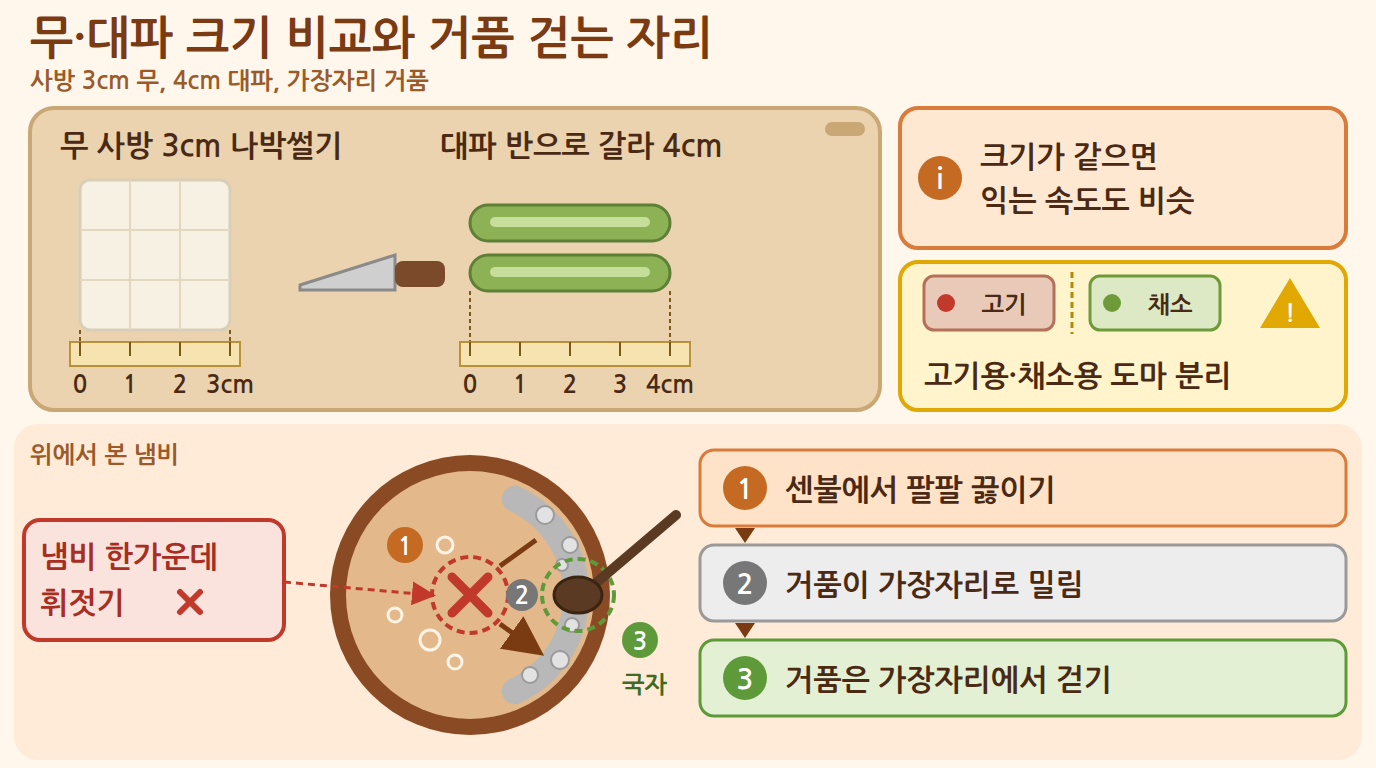
When preparing the food, watch out for cross-contamination (bacteria spreading from raw meat to other ingredients). Keep the beef separate from other ingredients until it is cooked, and prepare the radish and green onion on a separate cutting board. [2] You can save time by cutting the radish and green onion during the 10 minutes the beef rests. At this point, change the cutting board, or wash the board after handling the beef before cutting the next ingredient.
From Cutting the Radish to Simmering: Heat Levels and Timing
If you cut the radish into 3 cm squares and the green onion into 4 cm lengths, they cook at a similar speed in the pot. [1]
- Stir-fry the beef (medium heat): Heat the pot first, add the seasoned beef, and stir-fry over medium heat. The sesame oil is already in the seasoning, so you do not need to add oil separately. When the red color on the surface of the beef is gone and it turns brown, move to the next step.
- Add the radish (medium heat): Add the radish pieces and stir-fry them with the beef. When the edges of the radish turn translucent and the beef fat coats the radish and makes it glossy, it is time to pour in the broth.
- Pour in the broth and boil (high heat): Pour in 6 cups of kelp and anchovy broth and bring it to a rolling boil over high heat. [1][2] When it starts to boil, skim off the gray foam floating on top with a ladle. The foam is pushed to the edge of the pot and gathers there, so it is easy to scoop it up from that spot.
- Cover and simmer (medium-low heat): When the foam settles, cover the pot, lower the heat, and simmer for at least 20 minutes without stopping. [2] Even after it has come to a boil once, check partway through that the broth is clear. During this time, a rich flavor comes out of the beef and sweetness comes out of the radish.
- Check doneness: To cook meat safely all the way through, heat it for at least 1 minute after the center temperature reaches 75℃. [2] Take out one piece of beef, cut into the thickest part, and check that the color has changed all the way through. The radish is done when a chopstick goes in without resistance and the inside is translucent.
Stir-frying the beef and radish first is a way to set the cooking order. There are also recipes that skip stir-frying and put rinsed beef and radish straight into the pot with water and seasoning to boil. [2]
Seasoning and Finishing: Timing for Soup Soy Sauce, Salt and Garlic
Start with a mild taste and adjust at the end. The beef seasoning already contains 1/2 tablespoon of soup soy sauce, and the broth seasoning has a separate 1 tablespoon. [1] Together, the soup soy sauce comes to 1 and 1/2 tablespoons. [1] The salt is 1/2 teaspoon in the broth seasoning, and only a little is used in the beef seasoning. [1] The salty taste gets stronger as the soup reduces, so add the soup soy sauce first. Add salt only after it has come to a brief boil, and only if it needs more after tasting.
Add the garlic and green onion at the very end. When the broth has developed enough flavor, add the minced garlic and sliced green onion and boil briefly once more to finish. [2] Boil the garlic and green onion only briefly to keep their aroma. The minced garlic in the broth seasoning is 1/2 tablespoon. [1] Finally, sprinkle a little pepper to finish. [1]
Before serving, take a spoonful to taste the seasoning, and eat one piece of radish to check that the flavor has soaked in. If only the broth is salty and the radish is bland, boil it once more so the flavor soaks in.
Substitutes for Missing Ingredients and Seasoning for Children
- Cut of beef: Instead of brisket, you can use beef sliced for bulgogi or shank. A relatively tender cut is good. [3] Shank has a chewy bite.
- Broth: If you do not have kelp and anchovy broth, you can boil the beef and radish in water. A typical recipe boils 800 ml of water with 1 tablespoon of soup soy sauce, 1.5 spoons of tuna fish sauce, and a little coarse salt. [2] The water and seasoning change with the amount of beef and radish, so adjust them to the amount you have at home. There are also recipes that use only kelp broth. [4]
- Spicy variation: This version, for 4 to 5 servings, uses 250 g of beef (brisket or shank), 1/3 radish, 100 g of bean sprouts, 2 stalks of green onion, 1 red chili pepper, 2 tablespoons of chili powder, and 6 cups of kelp broth. [4] Here, the beef seasoning uses 1 tablespoon of soy sauce and 1 tablespoon of mirin (sweet rice wine), and the broth seasoning is 1/2 tablespoon of soup soy sauce, 1 tablespoon of minced garlic, and 1 teaspoon of roasted coarse salt. [4] Unlike the basic recipe, 100 g of bean sprouts is added.
- For babies: Beef and radish soup for a baby should be seasoned less than regular beef and radish soup. [3] Make it as regular beef and radish soup, not the Gyeongsang-style version. [3] An easy way is to set aside the adult portion first and season it, and not add soup soy sauce or salt to the baby's portion.
How to Store Leftover Beef and Radish Soup in the Fridge or Freezer
Store leftover soup in the fridge or freezer, depending on when you will eat it.
- Cooked food is recommended to be eaten within 2 hours of making it. [2] Set aside the soup you will keep first and cool it quickly.
- Leftover soup can be safely reheated and eaten only if the fridge is kept at 5℃ or below. [2]
- To freeze it, use a heat-resistant container, or let the soup cool completely before storing it. [3]
- You can freeze it in a plastic container or a zipper bag. [3] For zipper bags, divide the cooled soup into single-meal portions and freeze the bags lying flat. This makes them easy to take out and use. [3]
- When eating, take it out and thaw it, or move the block into a pot, warm it slowly, and bring it to a boil. [3] If the broth runs short while reheating, add a little water and check the seasoning again.
- Prepared soup beef that you have not yet used in the soup should be divided into airtight containers and stored in the fridge or freezer. [5] The storage period for this beef is 1 week in the fridge and 6 months in the freezer. [5]
Frequently Asked Questions
Q1. Can I use beef for bulgogi instead of brisket, and do I have to remove the blood?
You can use beef for bulgogi. A relatively tender cut such as bulgogi beef, brisket, or shank is good. [3] Whatever the cut, the broth is clearer if you remove the blood. Soak it in cold water for about 10 minutes, then drain and use it. [1] Thin bulgogi slices can get tough if boiled for a long time, so keep the stir-frying time short.
Q2. Can I reheat frozen soup right away without thawing it?
Yes. You can move the block into a pot, warm it slowly, and bring it to a boil. [3] Check that the soup has boiled enough before eating.
Q3. How do the seasoning and type of soup change when serving it to a baby?
It is good to season it less, and it is better to make it as regular beef and radish soup, not the Gyeongsang-style version. [3] Use the spicy variation with chili powder or red chili pepper only for the adult portion. For the baby's portion, it is easier to set it aside from the adult version before seasoning and boil it separately.