 Ethan Seo
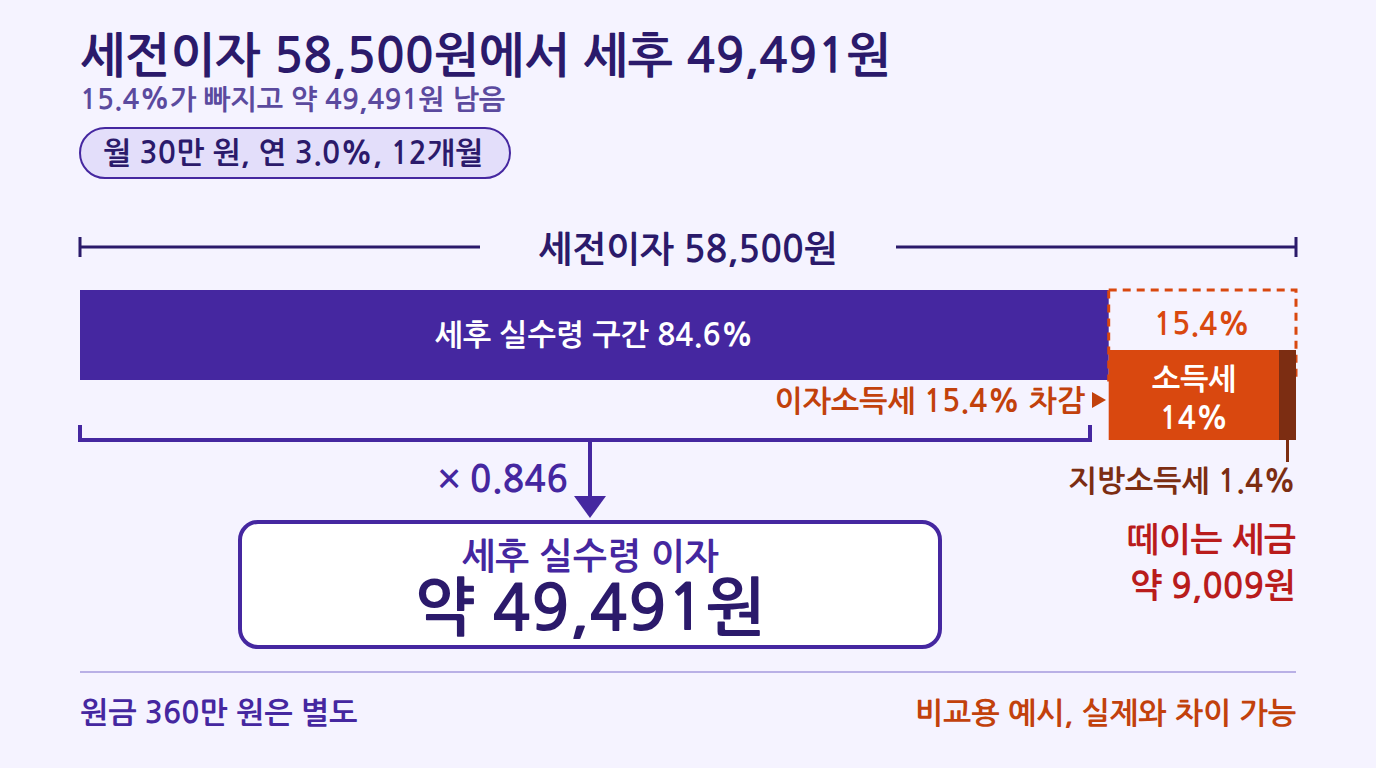
As of November 2026, a savings account with KRW 300,000 paid in each month for 12 months at 3.0% a year (before tax) earns KRW 58,500 in pre-tax interest. After the standard 15.4% tax, the after-tax interest is about KRW 49,491 [1].
In this calculation, do not multiply the 3.0% annual rate by the full principal of KRW 3,600,000. Multiply the monthly deposit by the annual rate and by 6.5, the average number of months interest applies [1].
After-tax savings interest formula: monthly deposit × annual rate × 6.5 × 0.846
A 12-month fixed-installment savings account (where you deposit the same amount every month) can be calculated in four lines, without a calculator [1].
- Pre-tax interest = monthly deposit × annual rate × 6.5 [1]
- KRW 300,000 × 3.0% × 6.5 = KRW 58,500 (monthly deposit KRW 300,000, total principal KRW 3,600,000) [1]
- After-tax interest = pre-tax interest × 0.846 [1]
- Pre-tax interest KRW 58,500 × 0.846 = after-tax amount of about KRW 49,491 [1]
0.846 is the value left after subtracting the 15.4% interest income tax. The 15.4% interest income tax combines 14% income tax and 1.4% local income tax [1]. The formula is 1 − 0.154 = 0.846.
The money you receive in your account at maturity is the KRW 3,600,000 principal plus the after-tax interest of about KRW 49,491 [1][1]. After tax is taken out, only part of the pre-tax interest remains. The after-tax interest rate is also the rate after deducting the 15.4% withholding tax on interest income in the same way [2].
Why you should not multiply the annual rate by the full principal
In a savings account, each monthly deposit earns interest for a different length of time [1]. The money deposited in the first month and the money deposited in the last month do not earn interest for the same period [1].
| Deposit number | Interest period |
|---|---|
| First deposit | About 12 months [1] |
| Second deposit | About 11 months [1] |
| Third deposit | About 10 months [1] |
| Last (12th) deposit | About 1 month [1] |
| Total for 12 deposits | 12 + 11 + 10 + … + 1 = 78 months [1] |
| Average interest period structure of the monthly deposit | 78 months ÷ 12 = 6.5 months [1] |
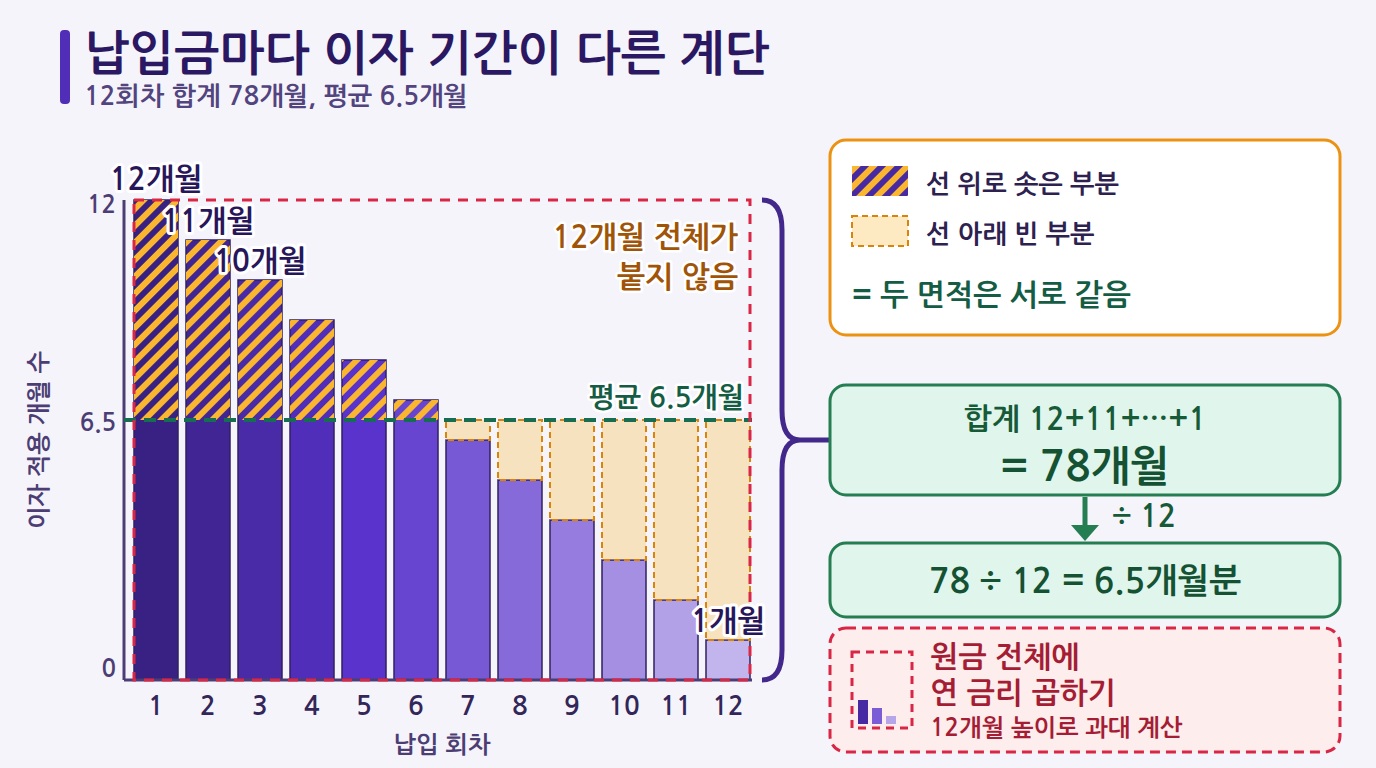
The structure is that the annual rate applies to the monthly deposit for an average of 6.5 months [1]. In the calculation, only 6.5 months of interest is added, not 12 months of interest.
If you multiply the annual rate directly by the full principal, you get a much larger amount than the actual pre-tax interest of KRW 58,500 [1]. This gap is the reason for the feeling that "you do not get the advertised rate." Pre-tax interest is about 1.6% of the total principal paid in [1]. That is lower than the stated rate.
After-tax payout by interest rate: KRW 300,000 a month for 12 months
The monthly deposit is fixed at KRW 300,000 and only the rate is changed. The 3.0% is the assumption in [1]. The same formula (monthly deposit × annual rate × 6.5 × 0.846) is applied [1][1].
| Annual rate (before tax) | Pre-tax interest (KRW 300,000 a month, 12 months) | Interest income tax 15.4% | After-tax interest received |
|---|---|---|---|
| 3.0% | KRW 58,500 [1] | 15.4% of pre-tax interest | About KRW 49,491 [1] |
The difference for each 1 percentage point of rate is also calculated line by line.
- Pre-tax interest = monthly deposit × rate difference × 6.5 [1]
- After-tax interest = pre-tax interest × 0.846 [1]
Verdict: You can compare rate differences by applying the same formula. So you should compare the base rate together with how likely you are to meet the bonus conditions.
This table is an example for comparison. Actual interest may differ depending on the product, the terms of enrollment, and the timing of deposits [1].
Base rate 3.10% vs top rate 4.60%: how much more do you keep if you meet the bonus conditions?
For a 12-month enrollment, the base rate is 3.10% a year (before tax). The bonus rates are a goal achievement celebration rate of 1.0 percentage point a year and a first-time customer bonus rate of 0.5 percentage point a year. If you meet all the conditions and cancel at maturity, a top rate of 4.60% a year (before tax) may apply [1]. The calculation uses a monthly deposit of KRW 200,000 for 12 months.
- Base rate, assuming a monthly deposit of KRW 200,000: KRW 200,000 × 3.10% × 6.5 = KRW 40,300 [1]
- Top rate: KRW 200,000 × 4.60% × 6.5 = KRW 59,800 [1]
- Pre-tax difference: KRW 59,800 − KRW 40,300
| Category | Applied rate | Pre-tax interest (KRW 200,000 a month) | After-tax conversion (× 0.846) |
|---|---|---|---|
| Base rate | 3.10% a year | KRW 40,300 [1] | Base-rate pre-tax interest × 0.846 |
| Top rate (all bonuses met) | 4.60% a year | KRW 59,800 [1] | Top-rate pre-tax interest × 0.846 |
| Effect of meeting the bonus conditions | Total bonus rate | Pre-tax difference | After-tax difference |
If you meet all the bonus conditions, you keep more even after tax. However, this amount applies only if all the assumptions below hold.
- The bonus rate is provided only if you meet the conditions during the contract period and cancel at maturity [1].
- If you do not meet all the conditions, a rate lower than the top rate applies [1].
- The goal achievement celebration rate of 1.0 percentage point a year is the largest of the bonus items [1].
Verdict: The top rate is a ceiling that assumes "keep the account until maturity and meet all conditions." Cancelling at maturity is a condition you can control. For the detailed conditions of the remaining bonus items, check the product terms. Before enrolling, first check whether you meet each bonus item, and it is safer to start the comparison from the amount at the 3.10% base rate. Treat the top-rate amount as a bonus.
How much less interest do you get if you cancel early?
If you cancel before maturity, the early termination rate may apply instead of the contract rate [1]. The bonus rate is also lost. This is because the bonus rate is provided only if you cancel at maturity and does not apply to early termination [1].
Your gain shrinks in two steps.
- Step 1: The bonus rate drops out. In the KRW 200,000 a month example, interest falls by the difference between the top-rate KRW 59,800 and the base-rate KRW 40,300 [1][1].
- Step 2: The remaining rate may also change from the 3.10% base rate a year to the early termination rate [1]. Pre-tax interest differs from KRW 40,300 [1] depending on what the early termination rate is.
Judge the break-even point this way. The extra income you could earn elsewhere after cancelling must be larger than "the lost bonus plus the drop to the early termination rate." Otherwise, cancelling is a loss. Before cancelling, check the early termination rate in the product terms and plug only the rate into the formula above. If you cancel early, the deposit period becomes shorter than 12 months, so you cannot use the average 6.5-month formula as it is.
Tax trap: 15.4% withholding and the KRW 20 million financial income threshold
The after-tax calculation in this article assumes standard taxation (interest income tax of 15.4%). 15.4% of the interest is withheld (the financial company deducts and pays it in advance before paying out) [1]. Under the Income Tax Act, the withholding tax rate on interest income is 15.4%, including 1.4% local income tax [2].
If interest income, dividend income and similar income add up to KRW 20 million or more in a year, comprehensive income tax may apply [2]. In this case, the amount multiplied by 0.846 is not the whole final tax burden.
You should also note that the calculator result and the actual deposit may differ. The Financial Supervisory Service's (금융감독원) comparison calculation applies rounding down to the won, and for compound-interest products it is an example amount calculated assuming monthly compounding. So the actual amount received may differ [2]. The 6.5 formula in this article is a simplified value for 12-month fixed-installment savings.
Here is a checklist before enrolling.
- Check that your tax category is standard taxation (15.4%) [1].
- See whether your total financial income this year, including interest and dividends, is close to KRW 20 million [2].
- Check the rate, bonus conditions and interest calculation method in the product details [2].
- Ask the financial company you will enroll with directly for the final amount [2].
This article is based on information as of November 2026. The actual rate applied may change if a financial company revises its terms or changes a product rate. Before deciding to enroll, check the product description of the financial company.
Frequently asked questions
Q1. Can I use the 6.5 formula as it is if my monthly deposit is different?
For 12-month fixed-installment savings, you only need to change the monthly deposit [1]. 6.5 is the average of the interest periods for each deposit, so it does not depend on the amount. For KRW 200,000 a month, it is KRW 200,000 × 3.10% × 6.5 = KRW 40,300 [1]. If the deposit differs each month or the term is not 12 months, the average period changes, so do not use this formula.
Q2. If the product is tax-free or separately taxed, do I not need to multiply by 0.846?
0.846 is a value that assumes 15.4% interest income tax [1]. If the product is not taxed, there is no tax to deduct, so the pre-tax interest is the interest you receive. For products with another tax rate, such as separate taxation, multiply by 1 minus that rate. Check the tax rate category of your product in the product details.
Q3. Why is the calculator result different from the interest actually deposited?
If you deposit after the set payment date, the interest period for that deposit changes and the 6.5 average no longer fits. Differences in calculation method, such as rounding down to the won, can also change the amount [2].
Q4. What happens if I meet only one bonus rate condition?
If the rates are added item by item, check the actual method in the product terms, such as whether only the goal achievement celebration rate is added to the base rate [1].