 Doyun Kim
As of November 2026, unemployment benefits (job-seeking benefits, 구직급여) are an existing system already in force. First, you must be able to answer "yes" to all three of the following questions. Were you enrolled in employment insurance for at least 180 days in the 18 months before leaving your job[1]? Was your departure involuntary, for reasons such as the company's circumstances[2]? Are you willing and able to work now[3]? In addition, active efforts to find new work are also required[3]. In principle, you cannot receive benefits if you quit on your own[2]. The deadline also matters. Once 12 months have passed from the day after you leave your job, you can no longer receive job-seeking benefits, even if prescribed benefit days (the maximum number of days you can receive benefits) remain, so you must apply right after leaving[4].
4 conditions for unemployment benefits: missing even one means no benefits
According to the Ministry of Government Legislation's Easy-to-Understand Legal Information (법제처 생활법령정보), there are 4 eligibility requirements[3]. If you fail to meet even one, you are not eligible for payment.
- Enrollment period: The insured unit period (the total number of days that served as the basis for wage payment) in the 18 months before the separation date must be at least 180 days[3].
- Willingness and ability to work: You must be willing and able to work but unable to find a job. Running a business for profit also counts as employment[3].
- Reason for leaving: You must not fall under the reasons that restrict eligibility (Article 58 of the Employment Insurance Act)[3].
- Efforts to find work: You must make active efforts to find new work[3].
All 4 requirements must be met, so if your enrollment period is under 180 days, you will not be paid even if you meet the other requirements[3]. That is why you check the enrollment period first.
How are the 180 days counted? Calculating the insured unit period
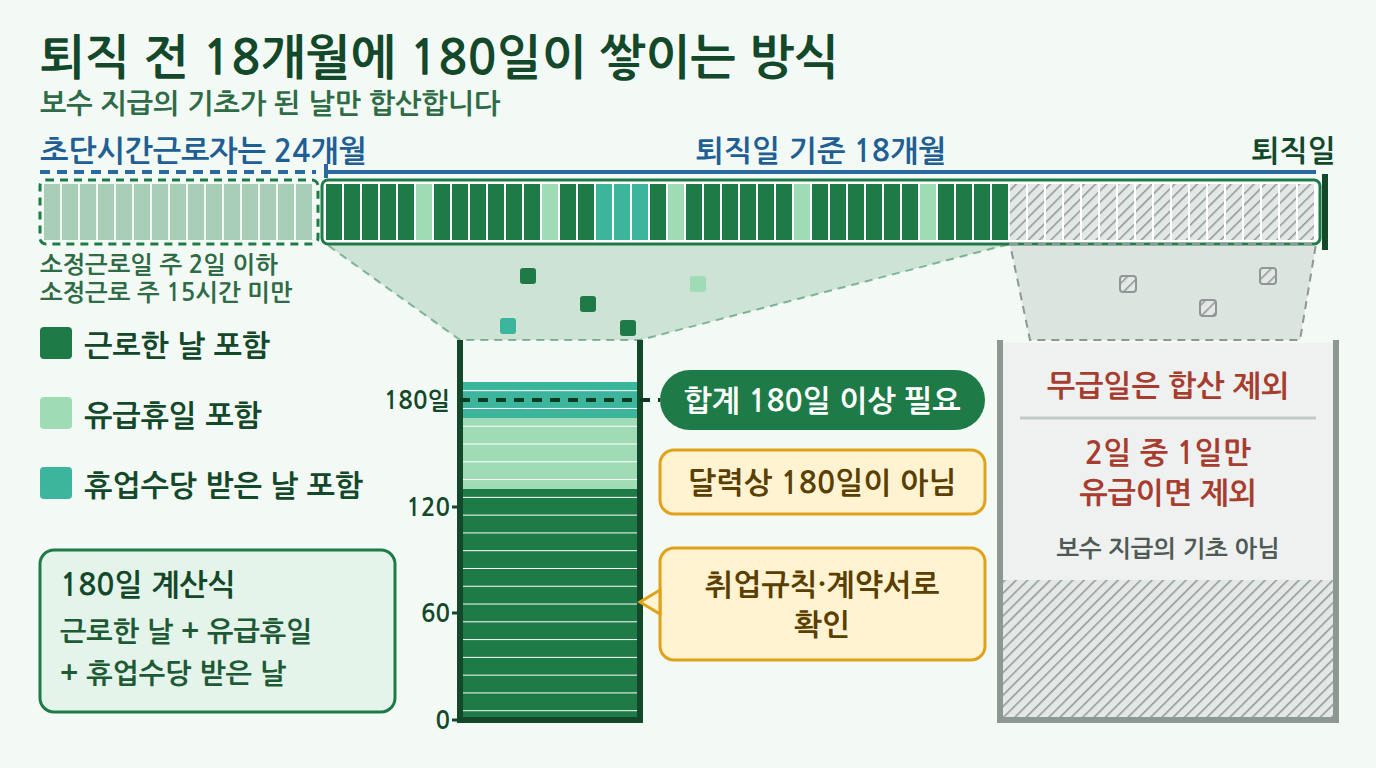
The basic reference period is the 18 months before you leave, and for ultra-short-hour workers it is 24 months[1]. An ultra-short-hour worker is someone whose scheduled working days are 2 or fewer per week and whose scheduled working hours are under 15 per week[2]. Eligibility is judged by the number of days accumulated within this period.
It is not 180 calendar days. The days that served as the basis for wage payment are added up[3]. The formula is "days worked + paid holidays + days for which you received business suspension allowance"[3]. Unpaid days off are not a basis for wage payment, so they are left out of the total[3].
| Category | Included in insured unit period? |
|---|---|
| Days actually worked | Included[3] |
| Paid holidays on which you did not work but received wages | Included[3] |
| Days for which you received business suspension allowance | Included[3] |
| On a 5-day workweek, the day that applies when only 1 of the 2 days off is paid | Excluded[3] |
| The day that applies when public holidays are not paid holidays | Excluded[3] |
Whether a holiday counts as paid differs by company, so you must check your rules of employment or employment contract[3]. If your employment insurance enrollment period is close to 180 days, the number of days recognized may change depending on the result of this check.
If you were sick or on leave, is the 18 months extended? Extending the reference period
The reference period is in principle the 18 months before the separation date, but it is extended if certain reasons apply[3]. If, during the 18 months before the separation date, you went without pay for 30 or more consecutive days for the reasons below, the reference period is the 18 months plus the days without pay. If the combined period exceeds 3 years, only up to 3 years is recognized[3].
- Illness or injury
- Business suspension at the workplace
- Leave due to pregnancy, childbirth or childcare
- Work abroad on the employer's orders (excluding cases where pay is provided in Korea)
- Industrial action under the Trade Union and Labor Relations Adjustment Act
- Reasons related to relatives living together (check the detailed scope in the notice on reasons for extending the reference period)
Even if your enrollment period looks too short, do not overlook these extension reasons. If you went without pay for 30 or more consecutive days because of childcare leave or long-term sick leave, you must recalculate using the extended reference period even if you do not reach 180 days within 18 months[3].
When you can receive benefits after quitting on your own: justified reasons for leaving
In principle, voluntary resignation does not qualify for benefits[2]. However, if you had no choice but to leave because of the company's circumstances or working conditions, it is recognized as a justified reason for leaving. Check the table below to see where your situation fits.
| Type | Recognized situations | Condition |
|---|---|---|
| Worsened pay or working conditions | Unpaid wages, reduced working conditions, pay below the minimum wage, or pay of less than 70% of the average wage before the suspension during a business suspension | Occurred for 2 or more months within 1 year before the separation date[2] |
| Overtime violations | Violation of the overtime limit in Article 53 of the Labor Standards Act | Occurred for 2 or more months within 1 year before the separation date[3] |
| Discrimination | Unreasonable discrimination based on religion, sex, physical disability, union activity and similar grounds | You were actually discriminated against at the workplace[2] |
| Difficulty commuting | Relocation of the workplace, transfer to another region, moving residence to live with a spouse or dependent relative, and similar cases | A round trip to the workplace by ordinary transportation takes 3 hours or more[3] |
| Leave or time off denied | Work is difficult because of pregnancy, childbirth or childcare, but the employer does not allow leave or time off. You must personally care for a parent or relative living with you for 30 or more days because of illness or injury, but this is not allowed | You left because of that[2][3] |
| Workplace crisis | Bankruptcy or closure is certain, or a mass layoff is planned | These circumstances existed at the time you left[2] |
For the unpaid wages and reduced working conditions type, "2 or more months" is the condition that the reason must have occurred for 2 or more months within 1 year before the separation date[2]. You should gather in advance bank statements, pay slips and your employment contract that show the period and amount of unpaid wages.
These cases are excluded: serious fault, self-employment and career change
Whether your reason for leaving falls under a restricted reason is decided by the head of the Employment Center (고용센터). If it does, you are regarded as having no eligibility[3].
- Sentence of imprisonment or heavier: You were sentenced to imprisonment or a heavier penalty for violating the Criminal Act or a law related to your duties[3].
- Unauthorized absence: You were absent without permission for a long period, in violation of your employment contract or rules of employment, without a justified reason[3].
- Other serious fault: You also cannot receive benefits if you were dismissed for embezzling company funds, leaking company secrets, destroying property and similar acts[2].
- Recommended resignation with serious fault: Benefits are also restricted if a person with serious fault was not dismissed but left on the employer's recommendation[3].
- Career change or self-employment: You left in order to change careers or start your own business[3].
- Leaving without a justified reason: You left for some other reason that is not a justified reason[3].
The form of a recommended resignation alone does not settle the outcome. The head of the Employment Center recognizes the reason for leaving[3], so what matters is the reason you actually ended up leaving. A recommended resignation caused by serious fault is restricted under the provision above[3], and one caused by a justified reason such as unpaid wages is judged separately under the recognized reasons in the previous section. It is best to prepare in advance documents that show the actual reason for leaving.
If you have no enrollment record, or you are a daily worker or civil servant
| Group | Standard that applies |
|---|---|
| National and local civil servants | They are workers excluded from employment insurance coverage and are not eligible to enroll[5]. |
| Daily workers (people who were daily workers at the time of their final separation) | The total number of days worked up to the date of applying for recognition of eligibility must be less than one-third of the total days in the same period[3]. |
| Construction daily workers | There must be no work record for 14 consecutive days before the date of applying for recognition of eligibility[3]. |
| Daily workers who have a history of leaving another business for a restricted reason | They must have worked as a daily worker for at least 90 days of the insured unit period in the reference period[3]. |
| Workers who were not enrolled in employment insurance | If you file a request to confirm insured status with the Korea Workers' Compensation and Welfare Service (근로복지공단) and it is confirmed, you can apply with the enrollment period for the 3 years before the year of confirmation recognized[2]. |
For daily workers, the structure requires proving the "state of not working" through the number of days worked. So the work record just before the application date is directly tied to the requirements. If you have no employment insurance enrollment record, you should check whether you can request confirmation of insured status from the Korea Workers' Compensation and Welfare Service before giving up[2].
Order of assessment to apply to your own situation, and preparation before applying
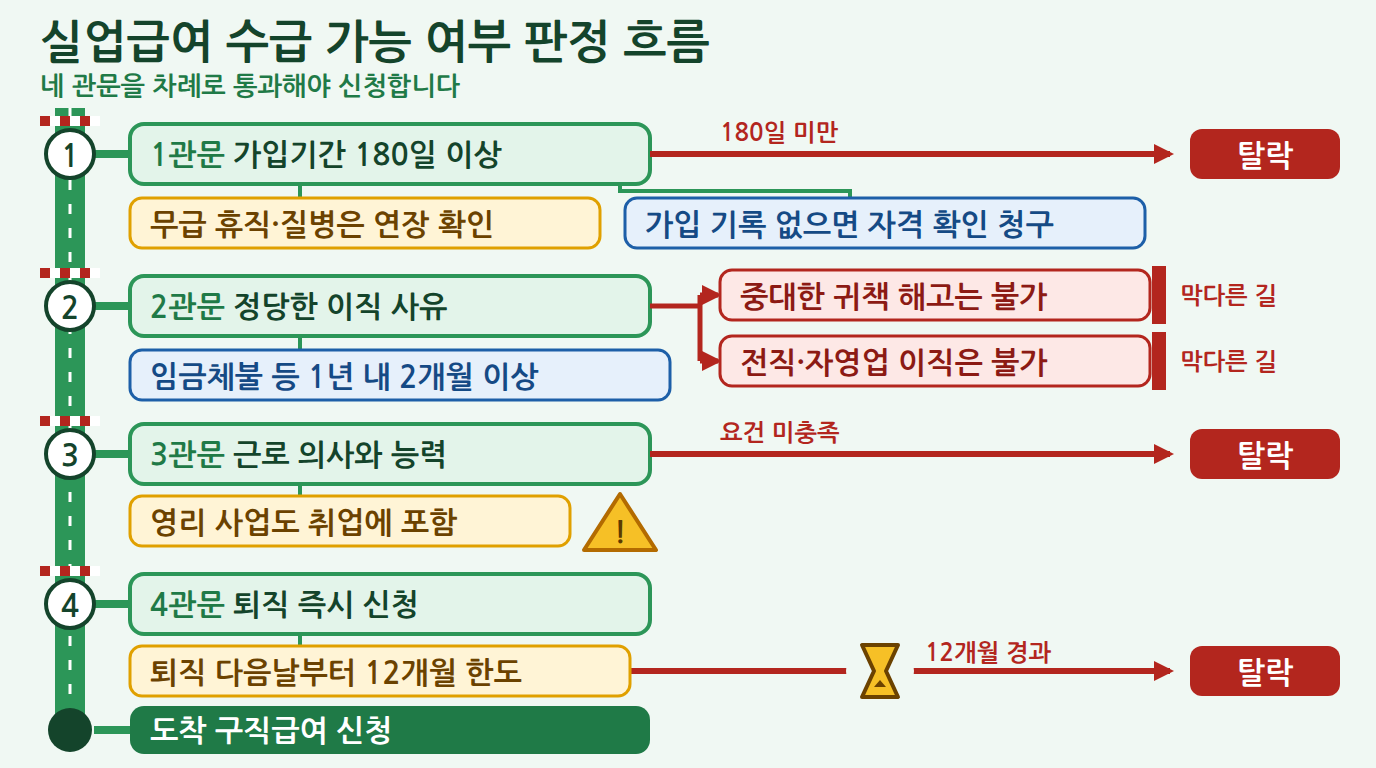
- Calculate the enrollment period: Check whether the insured unit period in the 18 months before the separation date (24 months for ultra-short-hour workers) is at least 180 days[1]. If you had unpaid leave or a period of illness, first check whether the reference period is extended[3].
- Classify the reason for leaving: Sort out whether it is a justified reason for leaving[2] or a restricted reason[3]. Organize the documents that prove it at the same time.
- Confirm willingness and ability to work: You must be willing and able to work, and running a business for profit also counts as employment[3].
- Apply immediately: Once you have finished the assessment above, go ahead with the application procedure without delay[4].
- Keep up your efforts to find work: Active efforts to find new work during the benefit period are a requirement[3].
Before applying, check whether holidays are paid using your rules of employment and employment contract[3]. If you claim unpaid wages or reduced working conditions, gather evidence covering 2 or more months within 1 year before the separation date[2]. If your reason is unclear, it is safer to explain it in detail at the application stage.
The requirements follow the standards in force under the law. Rumors of system reform or plans that have only been announced are not the basis for applying, so you must check an official notice of implementation before deciding.
Frequently asked questions
Q2. When is the 24-month period applied to ultra-short-hour workers?
Workers who meet this standard must have an insured unit period of at least 180 days within the 24 months before leaving[2].
Q4. If I quit to change careers, can it later be recognized as a justified reason?
This case is in principle restricted[3]. However, if the actual cause of leaving is a justified reason, such as unpaid wages or pay below the minimum wage that continued for 2 or more months within 1 year before the separation date, the Employment Center judges based on that reason[2][3].