 Jiwoo Choi
If you are considering applying for Youth Safe Housing (청년안심주택) as of November 2026, check three things first. First, are you a homeless person (someone who owns no home) aged 19 to 39 on the date the tenant recruitment notice is published? [1] Second, is your vehicle value KRW 37,080,000 or less? [2] Third, if you apply as a newlywed couple, have you been married for 7 years or less? [1] If you pass these three, the rent level depends on the type. Public rental is 30~70% of the nearby market rate, private rental special supply is 75%, and general supply is 85%. [3] For the youth group, in both 2nd and 3rd priority the average monthly income must be 100% or less of the previous year's average monthly income per household of urban workers, by household size. Total assets must be KRW 3 hundred million 4,500 ten thousand or less for 2nd priority and KRW 2 hundred million 7,300 ten thousand or less for 3rd priority. [2] However, amounts can change with each notice, so confirm them in the recruitment notice of the complex you want to apply for.
Checking Your Eligibility Before Applying for Youth Safe Housing
Youth Safe Housing is rental housing that the private and public sectors supply together near public transit stations. Its purpose is to stabilize housing for homeless young people and newlywed couples. [1] If any item below applies to you, you are disqualified before the income and asset standards are even considered.
- Age: The reference date for calculating age is the date the tenant recruitment notice is published, not the application date or the contract date. [1]
- No home ownership: You must meet the income, total asset and no-home requirements for your group. [1]
- Vehicle value: This is a common requirement for special supply and general supply. Your vehicle value must be KRW 37,080,000 or less. [2]
- Duplicate applications: Only one application per household is allowed. If you apply more than once, all applications are void. [1]
- Nationality: Foreign nationals cannot apply. [1]
The vehicle value rule does not say "you must not own a car." It says "the value must be at or below a set amount." If you own a vehicle and want to apply, check its value first.
Public Rental, Special Supply and General Supply at a Glance
In one Youth Safe Housing complex, 20% public rental housing and 80% publicly supported private rental housing are mixed. Tenant eligibility requirements differ by type. [2] Private rental is divided again into special supply and general supply. Special supply is about 20% of all private rental units, and general supply is about 80%. [3] Rent is set differently by supply type, area and size, so read the ratios below as relative levels compared with the nearby market rate. [3]
| Type | Share of units | Rent level |
|---|---|---|
| Public rental | Public rental 20% within one complex [2] | 30~70% of the nearby market rate [3] |
| Private rental special supply | About 20% of all private rental units [3] | 75% of the nearby market rate [3] |
| Private rental general supply | About 80% of all private rental units [3] | 85% of the nearby market rate [3] |
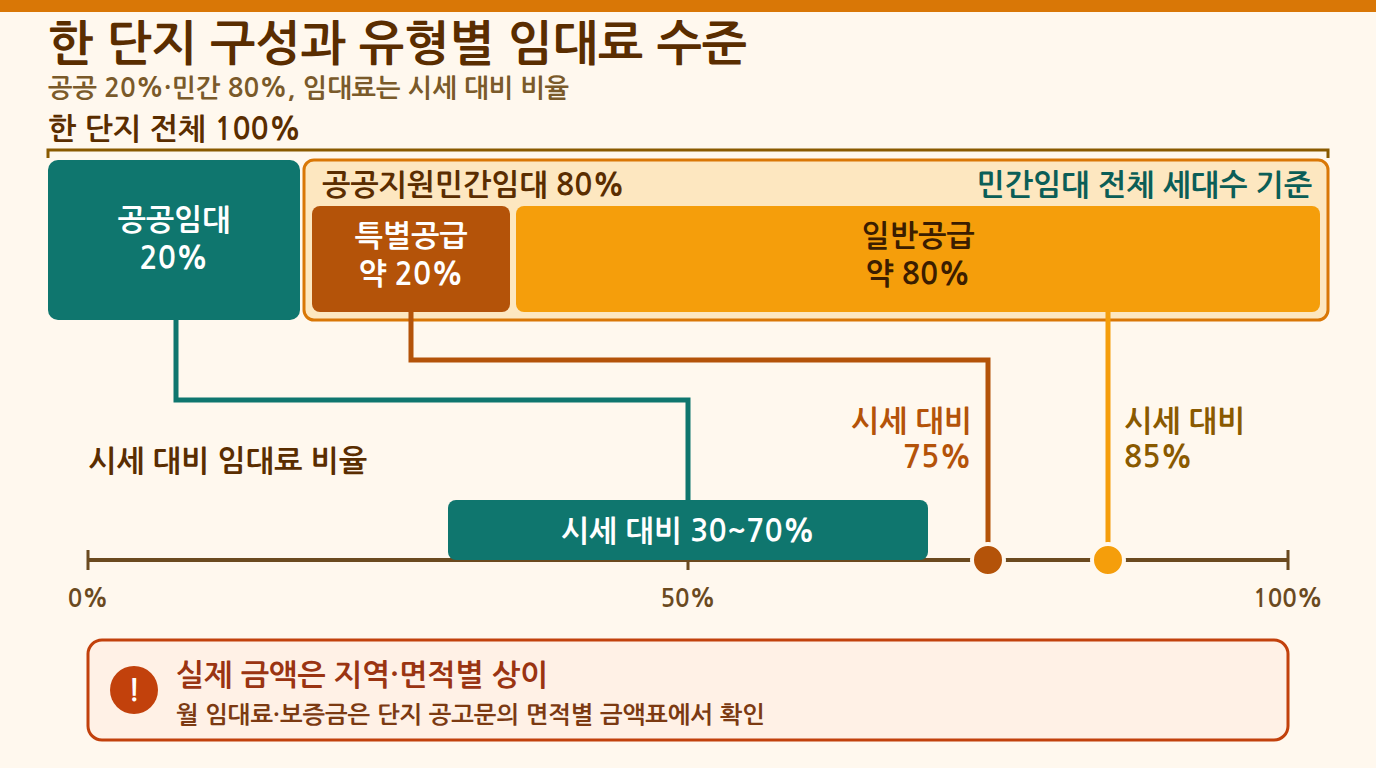
Public rental has a wide range of 30~70% of the nearby market rate. Private rental is set at 75% for special supply and 85% for general supply. If rent burden is your first concern, compare the ratios by type, but the actual amount varies by area and size. Check the actual monthly rent and deposit in the table of amounts by size in the complex's notice.
Income and Asset Standards Split Into 1st, 2nd and 3rd Priority
The youth group is made up of unmarried young people who are homeless and aged 19 to 39 on the notice date. They must meet the income, total asset and vehicle value standards for their priority. [4] The standards for each priority are in the table below.
| Priority | Target and income standard | Total asset standard |
|---|---|---|
| 1st priority | Households receiving living, medical or housing benefits, single-parent families, and near-poverty (second-lowest income bracket) households [2] | Check the notice |
| 2nd priority | The average monthly income of you and your parents is 100% or less of the previous year's average monthly income per household of urban workers, by household size [4] | Total assets of KRW 3 hundred million 4,500 ten thousand or less [2] |
| 3rd priority | Among people who do not fall under 1st or 2nd priority, your own average monthly income is 100% or less of the previous year's average monthly income per household of urban workers, by household size [4] | Total assets of KRW 2 hundred million 7,300 ten thousand or less [2] |
"Average monthly income per household of urban workers, by household size" is an income baseline published in statistics for each household size. The baseline that matches the applicant's household size applies, and it uses the previous year's figures. The upper limit can therefore differ at each notice date.
The point that separates the priorities is whether parents' income and assets are also counted. For 2nd priority, your income and your parents' income are added together. Assets are also assessed on you and your parents, using the National Rental Housing (국민임대주택) asset standard. [4] For 3rd priority, only your own income and assets are counted, and the Happy Housing (행복주택) (youth) asset standard applies to assets. [4] Even if your parents' income is high and exceeds the 2nd priority requirement, you can apply as 3rd priority if your own income and assets are within the 3rd priority standard. For 1st priority, benefit recipient or near-poverty status is recognized based on the applicant or on parents who are on the same resident registration certificate as the applicant. [4] The total asset amounts above can change with each notice, so compare them with the complex's recruitment notice.
What Is Different for Newlywed Couples
For the newlywed group, a period is the standard instead of age. The requirement that the applicant for housing supply has been married for 7 years or less is calculated by period, not by age, and the calculation date is the notice date. [1] If the marriage period exceeds 7 years on the notice date, you fall outside the requirement. If it is 7 years or less on the notice date, you meet the requirement regardless of the later contract date.
- Prospective newlyweds: You and your prospective spouse are regarded as one household. [1]
- Allowed residence period: Newlywed couples without children can live there for up to 6 years, and those with 1 or more children for up to 10 years. [2]
Conditions for Interest-Free Support When Your Rental Deposit Falls Short
Prospective tenants of special supply and general supply in private rental (publicly supported private rental) can receive interest-free rental deposit support if their rental deposit falls short. [2] The support cap depends on whether the deposit is KRW 100,000,000.
| Deposit range | Youth | Newlywed couples |
|---|---|---|
| Deposit of KRW 100,000,000 or more | 30% of the deposit interest-free, up to KRW 45,000,000 [2][2] | 30% of the deposit interest-free, up to KRW 60,000,000 [2][2] |
| Deposit under KRW 100,000,000 | Up to KRW 45,000,000 [2] | Up to KRW 45,000,000 [2] |
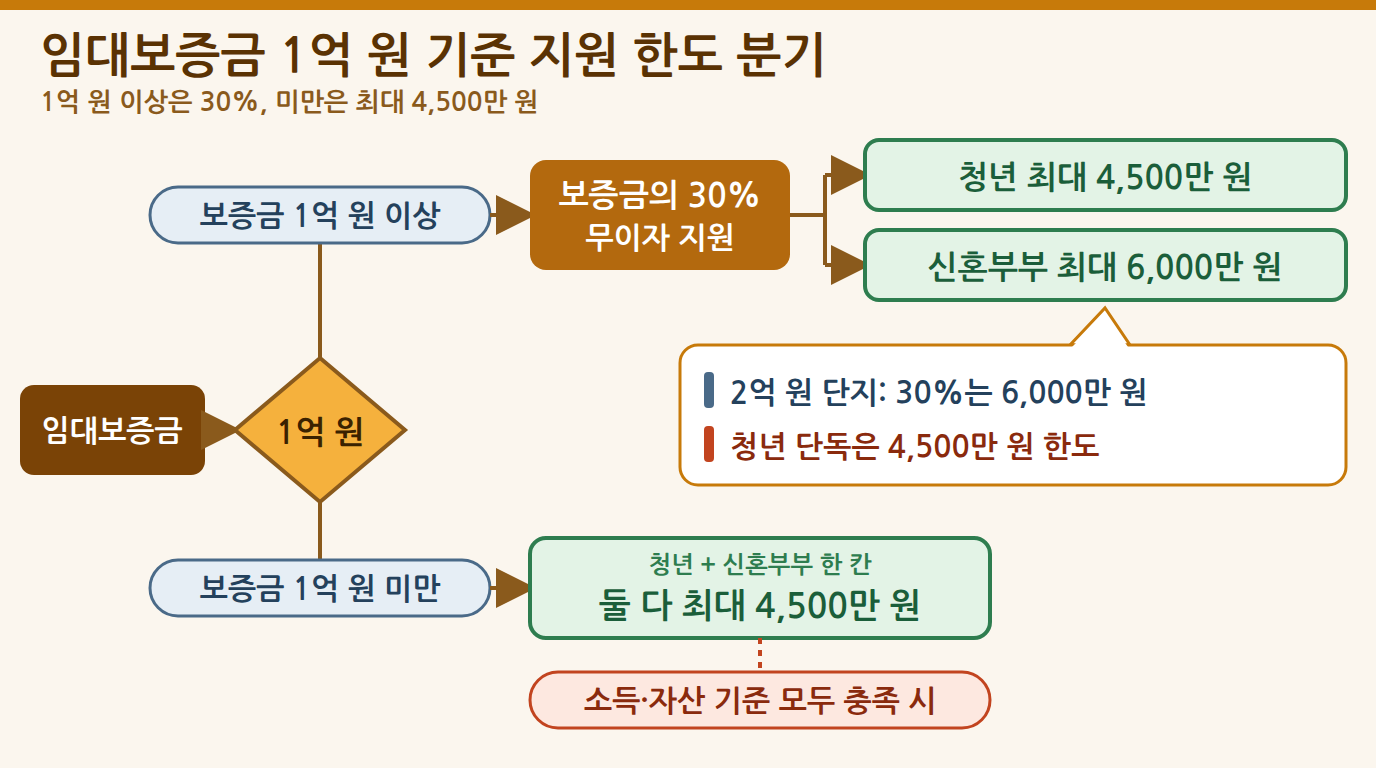
The KRW 45,000,000 in the under-KRW 100,000,000 range applies when both the income and asset value standards are met. [2] The application steps are as follows.
- First, sign the lease contract.
- After the contract, write the rental deposit support agreement.
- Visit the Youth Safe Housing Comprehensive Support Center (청년안심주택 종합지원센터) with the required documents and apply. [2]
The risky period when your money is tied up runs from signing the contract until you apply for support. The support application is made after the contract is signed, so support is not yet confirmed at the time of the contract. If you fail the income and asset standards, you must prepare the entire deposit yourself without support. Rather than building your funding plan on the assumption of support, it is safer to check before the contract whether you meet the income and asset standards. For deposit support inquiries, call the Youth Housing Division (청년주거과) at 1600-3456. [3]
What to Check Before the Contract: Contract Period and Responsibility for Returning the Deposit
Just before signing, compare the five items below with your documents. This step is not about estimating rent or market changes. It is about confirming the contract terms and who is responsible.
- Contract period: The first contract is for 2 years. If you meet the extension requirements and standards, you can renew every 2 years. [2]
- Renewal requirements: Renewal is not automatic and requires meeting the requirements, so check the extension requirements and standards in the notice in advance. [2]
- Residence cap: For newlywed couples, the cap on the allowed residence period differs depending on whether they have children, so apply the 6-year and 10-year split described above. [2]
- Responsibility for returning the deposit: Private rental type is a project carried out and operated by a private business operator, so responsibility related to the lease contract, including the duty to return the rental deposit, lies with that private business operator. [3] Check the landlord and business operator information in the contract.
- Order of the support agreement: Write the rental deposit support agreement after the lease contract. [2]
Public rental and private rental have different rent levels, and rental deposit support applies to prospective private rental tenants. Once you have chosen your application type, the final check is to compare whether that type's conditions are reflected in the contract as they are.
Frequently Asked Questions
Q1. What is the parking fee if I register a vehicle after moving in?
Residents are allowed to own and drive a vehicle. A vehicle that meets the registration standards for persons with disabilities, households with children, or livelihood vehicles can be registered with the complex and use the public parking lot at public parking lot rates. [1]
Q2. If I plan to marry, can I apply as a prospective newlywed and also apply separately as a young person?
No, you cannot. Prospective newlyweds are regarded as one household with the prospective spouse, so if you apply more than once, whether in the same group or a different group, all applications are void. [1] You must choose only one of the two groups.
Q3. Does the KRW 37,080,000 vehicle value standard also apply to general supply?
Yes, it does. The vehicle value standard above is common to special supply and general supply, so general supply applicants must also check their vehicle value first. [2]
Q4. How far do parents' income and assets count when deciding youth priority?
For 2nd priority, your income and assets are counted together with your parents' average monthly income and assets. For 3rd priority, only your own income and assets are counted. [4] The scope of recognition for 1st priority eligibility is you or parents on the same resident registration certificate, as explained above. [4]
Q5. If the deposit is under KRW 100,000,000, can newlywed couples also get up to KRW 60,000,000 in support?
No. If the deposit is under KRW 100,000,000, both youth and newlywed couples get up to KRW 45,000,000, and both the income and asset value standards must be met. [2]